North Carolina Turnout Surges as Final Push Begins
Over 2.8 million ballots have been cast in the state, marking a 30% increase over the 2022 midterms, with parties scrambling to mobilize unaffiliated voters in key races.
By Bianca Herrera ·
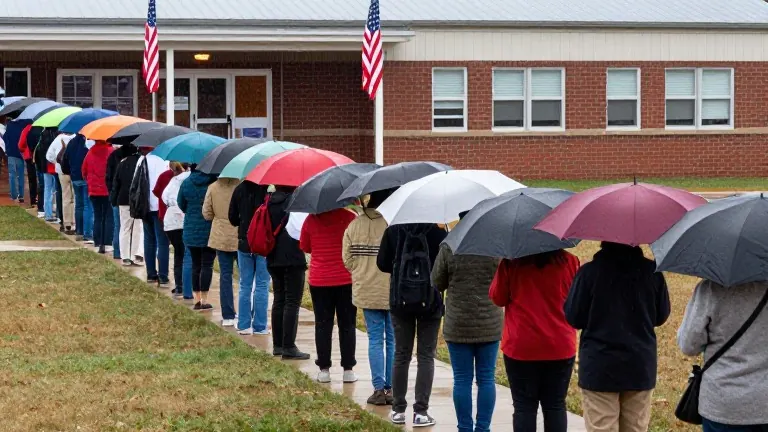
North Carolina voters have cast more than 2.8 million ballots through Sunday, a jump of over 30% compared to the same period during the 2022 midterms. This early surge has shifted the focus of political campaigns from long-term strategy to immediate mobilization. Parties are now working to convert this momentum into final votes on Election Day, specifically targeting unaffiliated voters in closely contested districts. The state’s Board of Elections reports that registered Democrats currently lead in turnout, followed by unaffiliated voters and Republicans, though the gap between the parties has narrowed in recent days.
State Democrats are prioritizing the closure of this gap before polls close. Anderson Clayton, Chair of the North Carolina Democratic Party, stated that the party is driving as many supporters to the polls as possible because historical patterns show higher Republican turnout on Election Day itself. Clayton emphasized the need to maintain pressure in the final hours to ensure their base shows up in force. This effort coincides with a broader push to reach voters who have not traditionally participated at high rates.
Republican leadership is also intensifying its ground game in the final 24 hours. Joe Gruters, Chair of the Republican National Committee, described a plan developed over six months to close the remaining turnout gap. He noted that the party is ensuring every voter understands the stakes of the upcoming elections. Gruters highlighted the role of President Donald Trump, who has made multiple trips to North Carolina to support Republican candidates. According to Gruters, Trump has successfully delivered low-propensity voters in past cycles, a dynamic the party hopes to replicate in the current race.
The presidential endorsement strategy is central to the Republican effort in the U.S. Senate race. Michael Whatley, the Republican candidate and former RNC Chair, has worked closely with Trump to energize the base. Gruters called Whatley an absolute superstar who is fighting hard daily. He predicted Whatley would perform well as the next United States Senator, leveraging the president’s rally presence to mobilize supporters. This approach contrasts with the Democratic strategy, which focuses on experience and consistent public service records.
Roy Cooper, the Democratic Senate candidate, has never lost an election, including victories in 2016 and 2020 with Trump on the ballot. Clayton argued that Cooper’s track record offers a clear alternative to candidates focused on corporate interests. She stated that voters need a public servant who works day after day rather than someone protecting special interest groups. This message aims to resonate with voters concerned about representation and accountability in Washington, D.C.
Unaffiliated voters represent the largest voting bloc in North Carolina and are viewed as a decisive factor in the outcome. Chris Cooper, a political science professor at Western Carolina University, noted that these voters are often younger and more movable with partisan tides. He assessed that the current surge in unaffiliated participation is likely better for the Democratic Party. Cooper also pointed out that voter perception of the economy will influence decisions, with a negative view hurting the party of the president, in this case, the Republicans.
Beyond partisan efforts, the group When We All Vote is working to increase turnout among young voters and communities of color. Kalisha Dessources Figures, a senior adviser for the organization, said the group is seeing record turnout in the state. They have launched a large-scale program at the polls based on data showing that celebrations can increase voter turnout by two to four percent. The group plans to hold 1,000 events on Election Day, including activities at UNC Greensboro and Queens University of Charlotte.
Polls will open at 6:30 a.m. Tuesday. Voters must be in line by 7:30 p.m. to cast their ballot. The final tally will determine the outcome of several key races, including the U.S. Senate seat and the First Congressional district, both of which are drawing national attention for their competitive nature.