
Alphabet drop weighs on Asian markets
Japan's Nikkei index fell sharply on Friday as investors reacted to a historic decline in U.S. tech stocks, while other regional benchmarks moved in different directions.
By Bianca Herrera ·
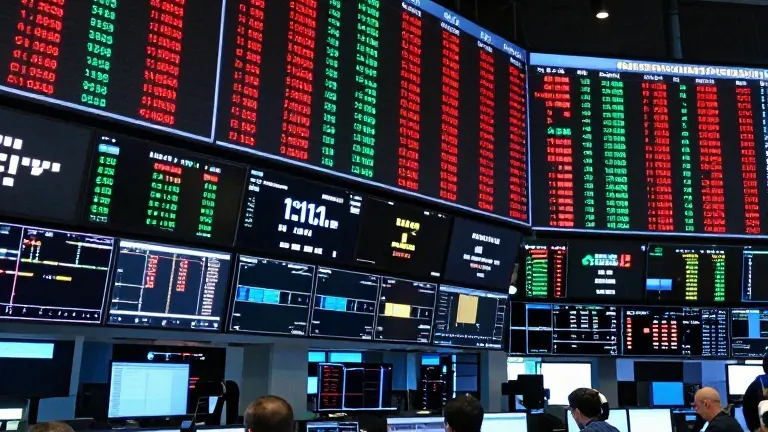
Japanese stocks opened lower on Friday, extending a period of volatility triggered by a steep drop in Alphabet shares on Wall Street. The Nikkei 225 index, Japan's benchmark, declined 2.6% to close at 62,960.60. This movement follows Alphabet's Class A shares falling 12.6% in their worst trading day since the company began public trading more than 20 years ago.
Market attention also turned to the Bank of Japan, which is concluding a two-day monetary policy board meeting. Most analysts anticipate the central bank will hold its benchmark rate steady at 1.25%, the level set after last month's increase. The U.S. government has recently pressured Japan to raise rates further, citing concerns over the weakening yen. In currency markets, the dollar slipped to 157.50 yen, down from 157.65, while the euro rose to $1.1197 from $1.1181.
Other Asian markets showed mixed results during the early session. Australia's S&P/ASX 200 index gained 0.5%, reaching 8,937.60. Conversely, South Korea's Kospi index suffered a sharp 5.4% decline to 5,618.76. The drop in Seoul was driven by morning trading losses in major technology firms, including SK Hynix and Samsung Electronics.
In China, the Hang Seng index in Hong Kong climbed 1.2% to 23,225.69. The Shanghai Composite index in mainland China moved in the opposite direction, losing 0.9% to settle at 3,618.14. These diverging trends reflect the varied impact of the U.S. tech sector's recent performance on different regional economies.
Traders have noted that stocks associated with artificial intelligence often experience heightened volatility. This sector sees prices pushed up by strong investor interest, only to face subsequent declines due to supply chain worries or other operational issues. The recent sell-off in U.S. tech stocks has amplified these fluctuations across Asian exchanges.
Back in the United States, the S&P 500 index fell 23.59 points, or 0.3%, to 7,720.39 on Thursday. This marked the index's first loss in four days, despite a majority of stocks within the benchmark rising. The Nasdaq composite, heavily weighted toward technology, dropped 365.13 points, or 1.4%, to 26,184.72. The Dow Jones Industrial Average declined 132.54 points, or 0.3%, to end at 52,342.56.
In the bond market, the yield on the 10-year Treasury note decreased to 4.94% from 5.05% late Wednesday. This follows a general pullback after the rate topped 5.30% earlier in the month, a level not seen since 2002. Energy prices also moved, with benchmark U.S. crude oil gaining 2.80% to $104.86 a barrel. Brent crude, the international standard, edged up 2.54% to $117.80 a barrel.
More Business · Customer Complaints · Report a business · Got a Story?