Breaking: From Record to Rout: Trump's 401(k) Post and the Nasdaq Slide
A historic drop in tech stocks follows Democratic wins and data center restrictions, raising questions for investors.
By Bianca Herrera ·
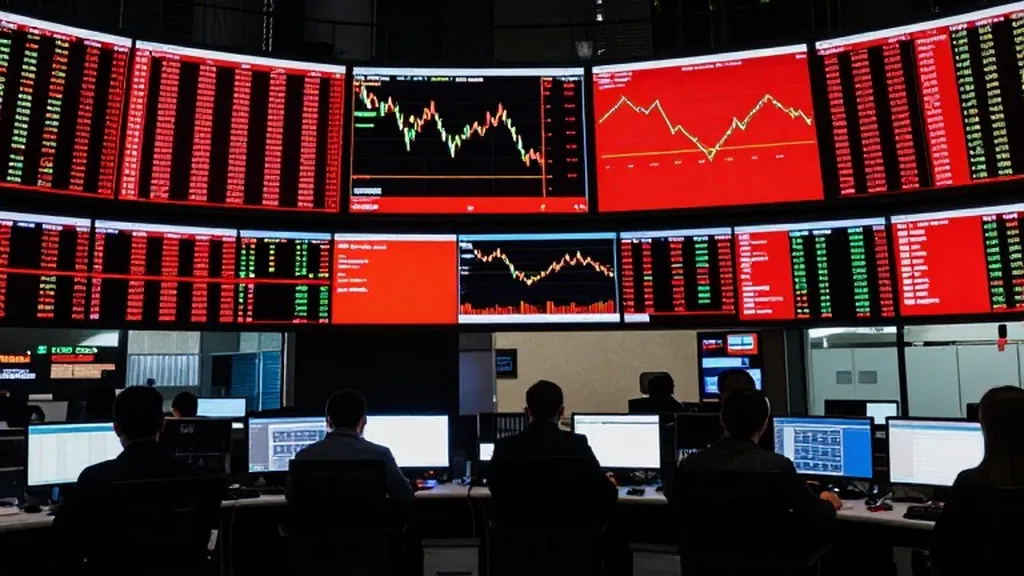
President Trump celebrated a record high on Truth Social on Wednesday, telling followers that their 401(k)s were through the roof and the market was record setting. By the close of trading on Thursday, that optimism had evaporated as the Nasdaq Composite fell 5.5 percent, its worst day in 18 months, and closed more than 11 percent below the record it set last month. This sharp decline placed the index in correction territory, a definition that requires a fall of at least 10 percent from a recent high. For savers and 401(k) holders who had just seen gains, the reversal was abrupt and painful, erasing the confidence that had built over the previous week.
The broader market damage was significant. The S&P 500 fell 4.3 percent, marking its worst day since April 2025. The Dow Jones Industrial Average dropped more than 1,800 points, a decline of 3.4 percent, to close at 51,868. This move erased the gains made on Wednesday, when the Dow had posted its biggest daily gain of the year. The selling spread through every sector of the S&P 500 and gathered pace as the day progressed, leaving investors scrambling to understand the shift in sentiment so quickly after a rally.
The trigger for the rout was the Democrats' sweep of the House and Senate in Tuesday's midterm elections. Democrats campaigned on slowing the spread of data centers and artificial intelligence, and voters in states with large concentrations of planned data centers, including Ohio and Texas, rejected these projects in a series of local ballots. In Texas, Democrat Gina Hinojosa won the governor's race after campaigning on an immediate moratorium on new data center construction. These victories heightened concerns that the facilities at the heart of the AI build-out would face new hurdles, pressuring companies tied to the artificial intelligence trade.
Technology stocks led the decline, with the so-called Magnificent Seven shedding about $1 trillion in value in the single trading day. Nvidia, the biggest faller in the Dow, dropped 9.2 percent, losing more than $400 billion in market value. The Philadelphia Semiconductor Index fell more than 12 percent, having already dropped more than 30 percent since the beginning of October. The iShares Semiconductor ETF fell 12 percent, its worst day since the Covid-19 breakout in March 2020. This sector-specific weakness reflected a broader concern that the huge sums being spent on AI might not pay off as expected.
Wall Street's fear gauge, the Cboe Volatility Index, jumped as much as 5.7 points to above 28 about 90 minutes after the opening bell. This was its highest reading since March 31, 2026, the day after the S&P 500 bottomed during the Iran war tensions. By midday, nearly 800,000 VIX call options had traded, which was 3.5 times the 30-day average. The 10-year Treasury yield fell to 4.83 percent, its lowest since September, as investors bought bonds as a haven, a move that signaled a retreat from riskier assets.
Investors now face difficult questions about the future of the market. Noel Smith, an options trader, said his data suggested de-risking, but his gut felt this was a blowout that could create a dip-buying opportunity. He noted that the tape looked like a liquidation, a term often used to describe forced selling that drives prices down rapidly. Neil Wilson, an investor strategist at Saxo UK, described a complete capitulation-level event in tech stocks, warning that the nature of selling everything in this market means investors need to look for stability first before making moves.
Historical data offers mixed signals for the coming months. Frank Cappelleri, founder of CappThesis, noted that the Nasdaq was higher 12 months after the election in all but one of 13 midterm cycles since 1974. However, he cautioned that the path can be a volatile one. In 2018, the Nasdaq rallied the day after Democrats won the House, but a sharp December sell-off followed, and the index was about 15 percent higher a year after the election. A review of 10 Nasdaq corrections over the last decade showed that while sell-offs in 2025, 2022, 2020, and 2018 were followed by further rough selling over the next month, the Nasdaq was back in rally mode six months later in every case except 2022.
The January 2022 correction remains the primary exception to this pattern. In that instance, the Nasdaq lost another 18.3 percent over the next six months and was down 24.3 percent a year later. On average, however, the Nasdaq gained 9.41 percent in the three months after a correction bottom and 17.03 percent over six months. Gene Goldman, chief investment officer at Cetera Financial Group, said the sell-off had become exaggerated and predicted a recovery, noting that corrections in a bull market are typically short-lived. He added that while the market was ugly right now, he believed a bounce back would occur soon.
The tech industry is also responding to the political shift. Greg Brockman, president and co-founder of OpenAI, said at the WSJ Tech conference in Napa, California, that everyone had been surprised by the reaction to data centers. He emphasized the need to be in communities rather than just tweeting that infrastructure projects are good. Dina Powell McCormick, president of Meta, told the same conference that the industry needed to double and triple down on telling the story of AI. As the market digests these changes, the focus remains on whether state-level restrictions will truly slow construction or if the AI trade will recover from this significant setback.
More Business · Customer Complaints · Report a business · Got a Story?