Swift telescope falls to Earth after 22 years
Solar activity accelerated the reentry of the aging observatory, ending a mission that outlasted its original two-year plan by two decades.
By Bianca Herrera ·
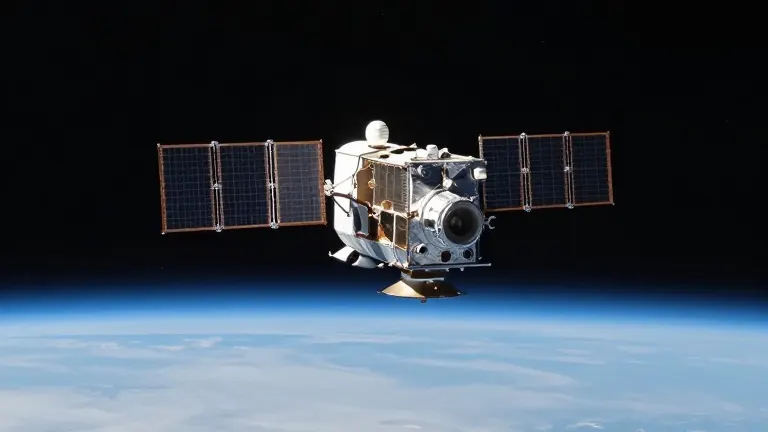
The Swift Observatory entered Earth's atmosphere near Indonesia on Wednesday. The U.S. Space Force confirmed the reentry after tracking the spacecraft's declining orbit. Solar activity over the past several years increased atmospheric drag, which pulled the telescope down from space.
NASA attempted a rescue earlier this year. The agency hired Katalyst Space to perform an orbit boost. That company launched a three-armed robotic craft in July. The vehicle malfunctioned and crashed in September. The failure occurred less than three months before Swift finally fell to Earth.
Swift launched in 2004 with a planned two-year mission to study gamma-ray bursts and exploding stars. It operated for 22 years, observing thousands of cosmic events. The telescope acted as a rapid response tool, pointing other observatories toward new sources for deeper analysis. Its lifespan was roughly 11 times longer than originally projected.
The spacecraft weighed 1.5 tons. It is not yet known how much material burned up during reentry. NASA expects some denser components to survive the passage through the atmosphere. The agency is currently assessing the debris field.
NASA is now evaluating private sector interest in saving another aging telescope: the Hubble Space Telescope. Launched in 1990, Hubble faces a similar fate due to solar storms. Recent analyses suggest it will reenter by the mid-2030s. The space agency is seeking proposals for orbit boosts, system upgrades, or controlled reentry plans.
Any rescue mission for Hubble must occur by 2032. NASA has more time to plan than it did for Swift. Nicky Fox, the agency's science mission chief, noted that the timeline allows for a more thorough exploration of options. Jared Isaacman, NASA administrator, stated that Hubble still has important science ahead of it. He said the agency should look at every reasonable opportunity to keep it operating.
The Swift mission ended without a controlled landing. The spacecraft was not designed for recovery. Its fall marks the conclusion of one of NASA's longest-running deep space observing programs. The Hubble decision will determine the next step in the agency's strategy for aging orbital assets.